
Why Power and Internet Outages Are an IT Problem in Jamaica
Every Jamaican business owner has the same story. The power cuts at 2:47pm on a Tuesday, the internet drops with it, and for the next 90 minutes nothing works. Phones are dead. Email is unreachable. The point-of-sale system is down. Staff stand around. Customers walk out. By the time JPS restores service, you have lost half a day of revenue and your team is too rattled to recover the other half.
Most businesses treat this as a JPS problem or a Flow problem. It is not. It is an IT problem, and it is solvable. The reason it keeps happening is that the IT setup at most Jamaican SMBs assumes power and internet are constants. They are not constants. They are inputs that fail regularly, and a business continuity plan that does not account for both is not a plan at all.
This article walks through what an outage-resilient IT setup looks like for a Jamaican small or mid-sized business, what each piece costs, and the order to implement it in if you cannot do everything at once.
The Real Cost of an Outage
Before getting into solutions, it helps to size the problem honestly. The conventional answer is "we lose a few hours of work." The actual answer is usually larger.
For a 20-person services business in Kingston billing roughly J$2.5 million in monthly revenue, a single 4-hour outage costs about J$60,000 in direct lost productivity, before you account for missed customer calls, delayed deliverables, or staff who give up and go home early. JPS reports an average of 2 to 4 unplanned outages per month in most service areas. That is J$120,000 to J$240,000 a month, every month, baked into the cost of doing business and almost never tracked.
The figure does not include reputational damage, which is real. Customers calling your business and hearing no answer, or hitting a dead website, do not always call back.
The fix is not to prevent outages. You cannot prevent JPS load shedding or a Flow fibre cut. The fix is to make your business operate normally through them.
The Three Layers of Resilience
A resilient setup has three layers. They build on each other, and skipping one undermines the others.
Layer 1: Power
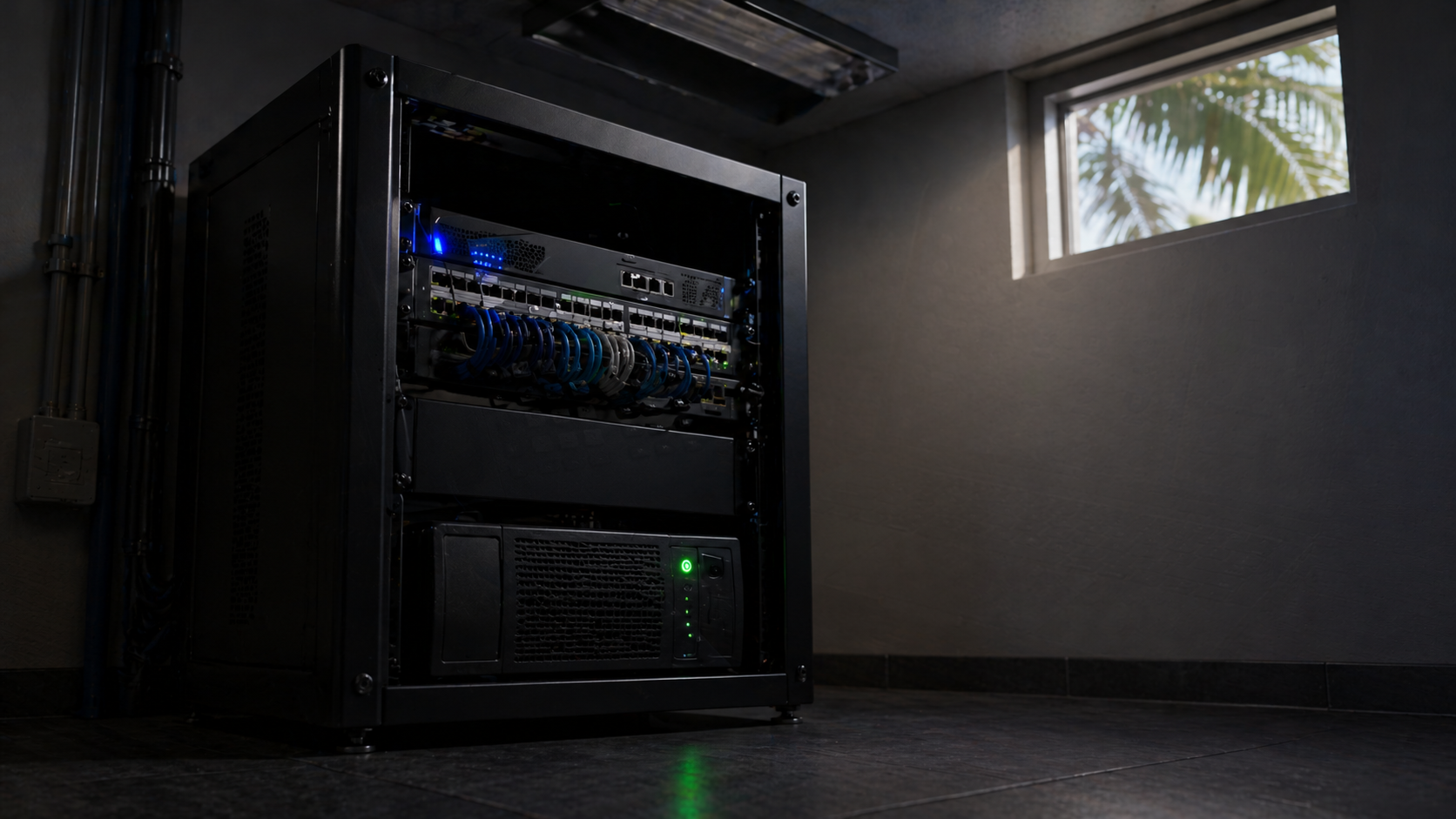
A standard UPS sized for your network and phone equipment costs between J$45,000 and J$120,000 depending on capacity and runtime. The goal is not to keep the office fully lit during an outage. The goal is to keep your network gear, your phone system, your servers, and a few critical workstations alive long enough for either JPS to restore power or for you to make an orderly transition to mobile work.
For a typical 20-person office, the right setup is:
- One rack-mount UPS for the server room and network gear, sized for 30 to 60 minutes of runtime. APC Smart-UPS SMT1500 or equivalent, around J$95,000.
- Smaller UPSes for individual critical workstations: reception, the dispatcher, the accounting desk. J$15,000 to J$25,000 each.
- A generator only if you genuinely need to keep the full office running through extended outages. For most SMBs, the UPS plus a "go home and work mobile" policy is more cost-effective than a J$1.2 million generator.
The mistake we see most often is undersized UPS units that give you 8 minutes of runtime, which is enough to save your work but not enough to keep operating. Spec the UPS for 30 minutes minimum on the equipment that has to stay live.
Layer 2: Internet
A power UPS does not help if your internet is also down, which it usually is, because the same outage that took out JPS also took out the Flow node serving your area. The fix is dual-WAN: two internet connections from two different carriers, with automatic failover.
For most Kingston and Montego Bay businesses, this means:
- Primary connection: business fibre from Flow or Digicel, whichever has better infrastructure to your building.
- Secondary connection: a second carrier on a different physical path, ideally a different last-mile technology. If primary is fibre, secondary can be 4G or 5G fixed wireless.
- A small business firewall or SD-WAN appliance that handles failover automatically. When the primary drops, traffic moves to the secondary in under 30 seconds, no human action required.
Cost: roughly J$20,000 to J$40,000 per month for the secondary connection, plus J$80,000 to J$200,000 one-time for the firewall or SD-WAN appliance, depending on whether you go with a Fortinet FortiGate or a smaller business unit. The math is the same as the UPS math: at J$60,000 per outage, two outages avoided pays for the secondary connection.
Layer 3: The Cloud Layer
Power and internet redundancy keep your office running. The cloud layer keeps your business running when your office is not an option, which matters for hurricanes, extended outages, and the occasional day when getting to the office is just not happening.
This means:
- Email and files in Microsoft 365 or Google Workspace, not on a local server. Your team can work from anywhere with an internet connection.
- The phone system on a cloud PBX, with mobile apps installed on every staff member's phone. When the office is offline, business calls still ring and get answered.
- Backups offsite, not just on a local NAS. A 3-2-1 backup strategy means three copies of your data, on two different media, with one offsite. The offsite copy is what saves you when a hurricane takes the building.
- Critical line-of-business applications either fully cloud-hosted or accessible over VPN from anywhere.
If you are still running an on-premise email server or your accounting software lives only on the receptionist's PC, you are one bad day away from a multi-week recovery. Move to cloud-first infrastructure as a matter of business continuity, not as a tech upgrade.
The Order to Do This In
If you cannot do everything at once, and most businesses cannot, the right sequence is:
- Cloud-first email and files. Migrate to Microsoft 365 or Google Workspace if you have not already. This is the biggest single resilience upgrade and pays for itself in productivity even before the next outage.
- Proper backups. A 3-2-1 backup strategy with offsite copies, tested monthly. Not "I think the backups are running." Tested.
- UPS for the server room and network gear. Sized for 30 minutes minimum.
- Cloud PBX with mobile apps. So calls keep working even when the office is dark.
- Dual-WAN with automatic failover. Two carriers, two paths, one firewall handling the cutover.
- UPS for critical individual workstations. Reception, dispatch, accounting.
- Generator. Only if extended uptime in the building specifically is required.
Most of our clients work through this list over six to twelve months, prioritised by which gap is causing the most pain. The total spend for a typical 20-person business lands around J$800,000 to J$1.5 million spread across that period, which is significantly less than the cost of the outages it prevents.
What This Looks Like in Practice
A Kingston accounting firm we work with had a JPS outage on a Wednesday morning in March. The power went down at 9:14am. The UPS in the server room kept the firewall, the cloud PBX hardware, and the network alive. The dual-WAN appliance failed over from Flow fibre to a Digicel 5G backup connection in 22 seconds. Staff laptops were already on battery. The cloud PBX kept ringing and routing calls to mobile apps. Three staff members went to a coffee shop with WiFi and kept working. The other twelve worked from the office on laptop battery for the first 90 minutes, then went home and continued from there.
JPS restored power at 1:30pm. The firm had lost approximately 35 minutes of effective productivity, all of it in the first 22 seconds of the outage and the few minutes of staff orienting themselves. The previous year, the same outage would have cost them most of the day.
That is what resilience looks like. It is not glamorous. It is six pieces of equipment configured correctly, plus a cloud-first approach to where your work actually happens.
Where to Start
If you want a clear picture of where your business is exposed, our Managed IT service starts every engagement with a continuity assessment: what survives a power outage, what survives an internet outage, what survives both, and what does not. We deliver a written report with a prioritised list of fixes, and you decide what to act on.
Get in touch if you want to schedule one. The assessment takes about a week and the report is yours whether you hire us afterwards or not.